The cheapest AI is 8,824 times cheaper than the most expensive
Everyone calls it the same thing: using an AI model. The price list says these are not remotely the same product.
At a glance
- Cheapest paid input
- $0.02 per million tokens
- Most expensive input
- $150 per million tokens
- The gap
- about 8,824 times
- Models on the list
- 446, of which 24 are free
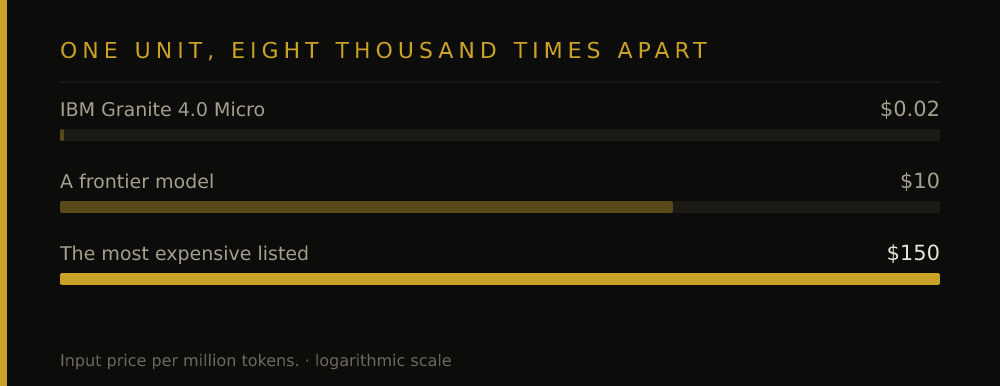
On one price list, on one afternoon, you could buy a million tokens of AI input for two cents or for one hundred and fifty dollars.
That is the same unit. The same kind of request. The same screenshots in every marketing page.
8,824 times is not a range, it is a different universe — and it is the single most useful fact about the AI market that almost nobody puts on a chart.
The two ends
At the bottom: IBM Granite 4.0 Micro at $0.02 per million input tokens. That is roughly 750,000 words for two cents. It is small, it is not clever, and it is entirely adequate for a great deal of real work.
At the top: o1-pro at $150 per million in, $600 per million out. Six hundred dollars for a million tokens of output — about three-quarters of a million words.
In between sit 446 models of every shape and price, including 24 that cost nothing at all.
Why the gap is so large
Three things separate the ends of that range, and only one of them is quality.
Size. A larger model costs more to run for every single token. The relationship is close to linear, and it is the largest single factor.
Deliberation. Reasoning models generate working before answering. You are billed for the thinking, which can multiply the cost of an answer several times over.
Positioning. Some of the price is not cost at all. It is what the market will bear for a model with a particular name attached, sold to buyers who are not comparing.
The mistake almost everyone makes
The default is to reach for the best model available, because the price difference per request looks trivial. A tenth of a cent. A few cents. Nothing.
Then it is not nothing, because you did it four hundred thousand times.
At the volume where AI becomes genuinely useful — every ticket, every invoice, every document, every commit — the difference between the top of that range and the bottom is the difference between a hobby and a business.
What to do with this
Sort your tasks into two piles.
The boring pile: classification, extraction, formatting, summarising text you supplied, translating. These have right answers and the cheap models get them right. Pay two cents.
The hard pile: reasoning that has to be correct, code that has to run, decisions where being wrong costs more than the tokens. Pay whatever it takes, and be glad it only happens sometimes.
Most people run everything through the expensive pile and call the bill the cost of AI. It is not the cost of AI. It is the cost of not sorting.
Every claim in this file is checked against primary sources — how we verify. Spotted an error? Tell us.
Get the next file before it's public
One story a week, chosen from the archive. The kind you repeat at dinner and nobody believes.
One dispatch a week. Unsubscribe anytime.
More Money
AllThe two biggest AI models cost exactly the same
OpenAI's newest flagship and Anthropic's newest flagship are priced identically, to the cent. That is not a coincidence, and it tells you something about where the market has gone.
The Great Salad Oil Swindle
Inspectors measured the tanks with a tape dipped in water. Oil floats. One man used that fact to borrow against $150 million of soybean oil that did not exist.
Was Tulip Mania Even a Bubble?
The most-cited financial bubble in history may be mostly a story invented 200 years later by a man selling a book about crowd madness.