The two biggest AI models cost exactly the same
OpenAI's newest flagship and Anthropic's newest flagship are priced identically, to the cent. That is not a coincidence, and it tells you something about where the market has gone.
At a glance
- GPT-6 Astra
- $10 in / $50 out per million tokens
- Claude Fable 5.1
- $10 in / $50 out per million tokens
- Both, in batch mode
- $5 in / $25 out
- Context window
- about one million tokens each
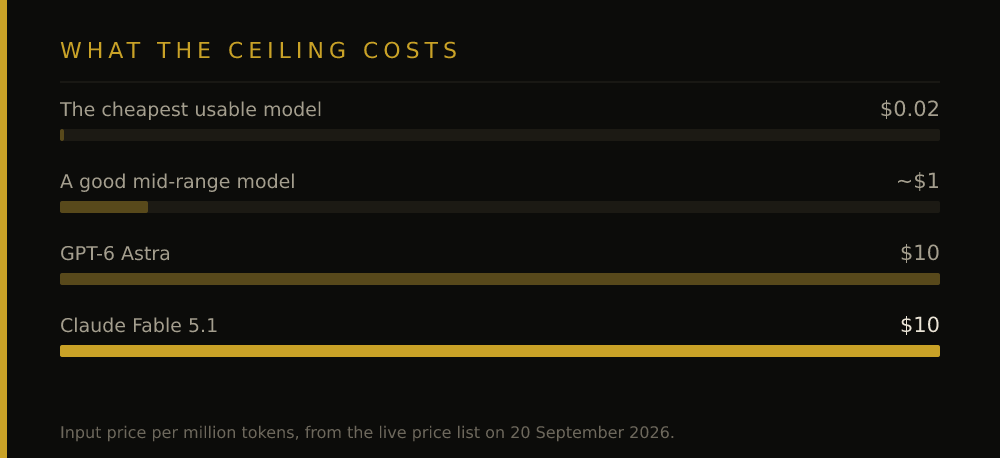
The two most capable models on the market are OpenAI's GPT-6 Astra and Anthropic's Claude Fable 5.1. They are made by competing companies, trained on different data, and do not behave identically.
They cost the same. Not roughly — exactly.
The numbers
| Input, per million tokens | Output, per million tokens | Context | |
|---|---|---|---|
| GPT-6 Astra | $10.00 | $50.00 | 1,050,000 |
| Claude Fable 5.1 | $10.00 | $50.00 | 1,000,000 |
Both also offer a batch rate of half that — $5 in, $25 out — for work you are willing to wait on.
Two companies, two architectures, one price list.
Why this happens
When two products are priced identically at the top of a market, it is rarely because they cost the same to run. It is usually one of three things.
They are watching each other. Frontier labs price against the competitor one tier below their own, not against their own costs. A visible price list is a public commitment, and matching it is safer than undercutting and starting a war neither wants.
The buyer is not price-sensitive. At this level the customer is a company deploying an agent across thousands of tasks, or a developer who has already built on one of them. Switching costs more than the difference.
It is the reference point. $10 per million input tokens has become the number that means frontier. Pricing above it needs an argument. Pricing below it invites the question of what was given up.
What it means if you are paying
The interesting comparison is not between these two. It is between either of them and the model two hundred times cheaper that will do most of your actual work.
That same day's price list included models at $0.02 per million input tokens — the same unit, the same API, the same task, twelve thousand times less money.
For classifying support tickets, extracting fields from invoices, or summarising a document, the cheap model is not a compromise. It is the correct choice, and the money you did not spend is the return.
The frontier price is for the hard 5% of problems. Most people pay it for the easy 95%.
The honest part
Equal pricing does not mean equal quality. It means the two companies have agreed, without ever discussing it, on what the ceiling costs.
Your job is to work out which of your tasks actually needs the ceiling — and it is fewer than you think.
Every claim in this file is checked against primary sources — how we verify. Spotted an error? Tell us.
Get the next file before it's public
One story a week, chosen from the archive. The kind you repeat at dinner and nobody believes.
One file a week. Opens your mail app, pre-filled.
More Money
AllThe Great Salad Oil Swindle
Inspectors measured the tanks with a tape dipped in water. Oil floats. One man used that fact to borrow against $150 million of soybean oil that did not exist.
Was Tulip Mania Even a Bubble?
The most-cited financial bubble in history may be mostly a story invented 200 years later by a man selling a book about crowd madness.