The Pigeon That Saved 194 Men
Shot through the chest, blind in one eye, one leg hanging by a tendon — and still carrying the message that stopped the artillery.
At a glance
- Unit
- US 77th Division, "Lost Battalion"
- Date
- October 1918, Argonne Forest
- Survivors
- 194 of roughly 550
- Decoration
- Croix de Guerre with palm
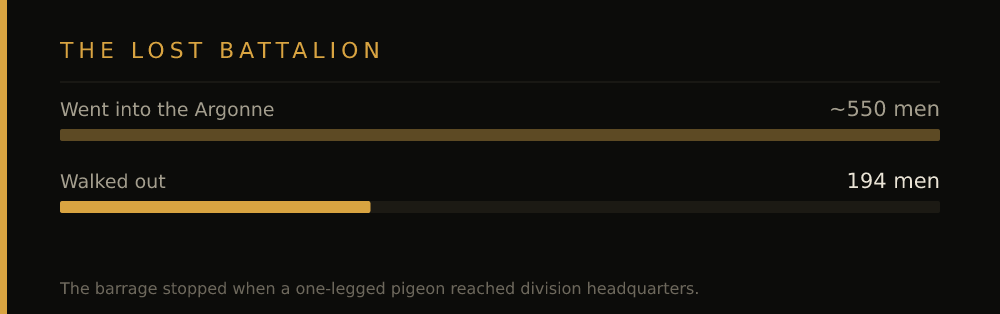
In October 1918, in the Argonne Forest, roughly 550 men of the US 77th Division were cut off and surrounded. They became known as the Lost Battalion, and their problem was not the Germans. It was their own artillery.
American shells were falling directly on their position. Major Charles Whittlesey had already lost most of his runners, and every pigeon he sent with a ceasefire request was shot down. He had one bird left.
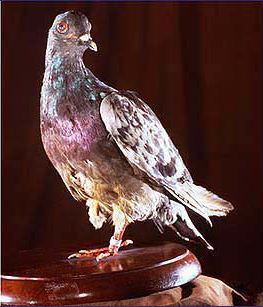
The pigeon was called Cher Ami. He was carrying a message on a small canister attached to his leg: "We are along the road parallel to 276.4. Our own artillery is dropping a barrage directly on us. For heaven's sake, stop it."
Cher Ami launched into fire. He was hit almost immediately. A bullet passed through his breast. Another destroyed the leg holding the message, leaving it attached only by a strip of tendon. He was blinded in one eye. He kept flying. He covered about 25 miles in under half an hour and reached division headquarters, where the message was taken from his ruined leg.
The barrage stopped.
Of the roughly 550 men who had gone in, 194 walked out.
Cher Ami was treated by army medics and given a wooden leg. He was awarded the Croix de Guerre with palm — a French military decoration for bravery — and became a celebrity in the United States. He died in June 1919 from his wounds, and he is still there: taxidermied, one-legged, in the Smithsonian National Museum of American History.
There's an uncomfortable detail here worth sitting with. The army had tried radio, telephone, runners and signal flares. All of them failed. The thing that worked was a bird that nobody had much faith in, doing something that cost it almost everything.
Every claim in this file is checked against primary sources — how we verify. Spotted an error? Tell us.
Get the next file before it's public
One story a week, chosen from the archive. The kind you repeat at dinner and nobody believes.
One file a week. Opens your mail app, pre-filled.
More History
AllThe Dead Man Who Fooled the Nazis
Operation Mincemeat used one corpse, a fake major, and a set of letters to move an entire German division.
Boston's Tidal Wave of Molasses
A tank of syrup burst in 1919 and sent a wave through the streets at 35 mph. The smell lasted for decades.
The Librarian Who Smuggled 350,000 Manuscripts
When extremists seized Timbuktu, one man spent months moving a civilisation's records out of the city in metal trunks.